



One of the most important working tools for repairing electrical equipment and machinery is a multimeter. This tool can be found in every electronics lab, repair shop and every workshop. Multimeter has two types analog (manual) and digital (digital), analog type is old and not used anymore. If your profession is such that you deal with electrical and electrical equipment; Nothing is more important to you than getting an accurate multimeter. Considering the vital importance of this equipment in electrical work; In this article we intend to introduce the multimeter from the Taban Control Daghigh website and explain its use. stay with us
What is a multimeter?
A multimeter can be said to be a measuring device. This device has the ability to measure current, ohmic value and electric quantity; In addition, some multimeters can measure the capacitance of the capacitor and the alternating frequency of the signal. Another of its uses is to check whether the bases of diodes and transistors are healthy or defective. You can test the circuit connection using a multimeter. Due to the measurements of this device, it is also called AV Ometrr in some places. This abbreviation comes from Ampere, Volt and Ohm.
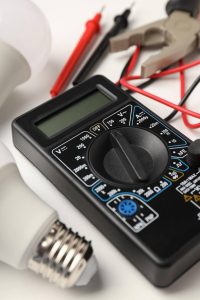
Multimeter distribution
analog: This multimeter looks like an odometer. The components of this type of multimeter are: an indexing screen, a moving pointer on the screen, a selector, a zero potentiometer, a number of terminals and two digital interface cables. If we want to compare this type of multimeter with a device, we can say that it is almost similar to digital weighing scales. This type displays the measured quantities in numbers and in their corresponding units.
Bench multimeter: This type can be mentioned as a subset of the digital type. However, it is more accurate than a simple digital version. Because of this high accuracy, it is widely used in the laboratory instead of the benchtop multimeter.
Clamp Multimeter: A clamp-on type multimeter is also digital and, in addition to the above functions, also has a rake. With these rakes, the current flowing through it can be measured without the need for a multimeter to be connected in series with the circuit element.
If we place a current-carrying wire between the forks of this device; It will show the amount of current passing through the wire and circuit. Therefore, due to the clamp type of this device, the flow measurement is very fast. Now that you know the different types of multimeters and their uses, in the rest of this article we want to explore the uses of its different types in more detail and in general.
Multimeter Applications
1. Home application:
Avometer should be in every home. Checking continuity, testing faulty sockets, testing household appliances and other home circuit tests are made easy by this tool. While there is no specific brand of meter for home use; But any type of method that can measure the basic parameters will do.
2. Industrial applications: Multimeters can be used for countless industrial tasks. The need to use this device also appears in many engineering tasks; such as conducting continuity tests, measuring the temperature of devices, evaluating current, and analyzing circuits through infrared imaging.
3. Testing all types of electronic components: Testing the condition or failure of various components such as capacitors, transistors, diodes, etc. is one of the most basic uses of an ammeter. The multimeter has various tests; To do our test, it is enough to automatically set the mode and then start the test. For example, testing capacitors is one of the most common tests.
last word
In this article, we try to present different types of multimeters and their different uses. However, working with this device is not particularly complicated; But because of the influence of the numbers displayed by the multimeter on the results of your work, it is better to know how to use it and the factors that affect it before you start working. Tappan Control Daghigh is always ready to answer your questions in this field.